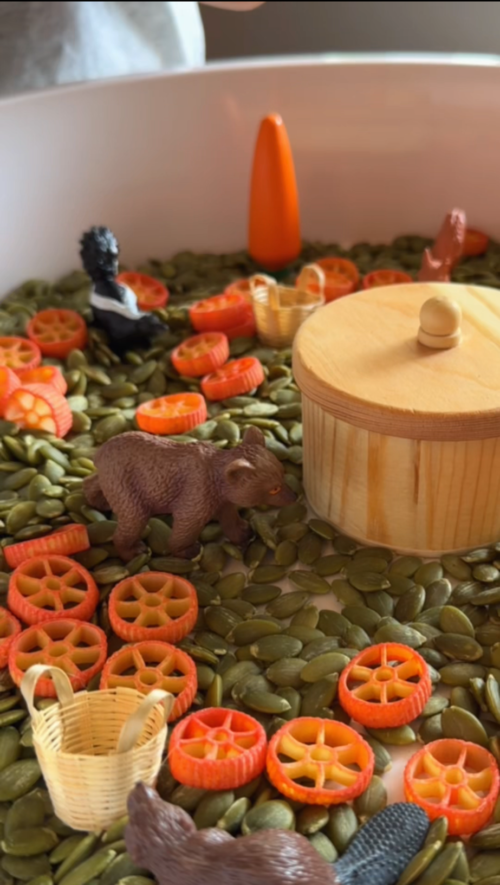
Simple sensory play with a few materials that can spark so much playtime. I created a woodland-inspired setup for my 3-year-old to explore, and he ended up playing with it for 103 minutes.
What I loved most wasn’t just how long he played. It was seeing all the different types of play that came naturally from one setup. He counted pumpkin seeds, filled and emptied baskets, fed the woodland animals, and used tongs to transfer the little pasta “pumpkins.”
If you’re looking for an easy fall sensory activity for toddlers or preschoolers, this one has plenty of opportunities for fine motor practice, counting, pretend play, and early concepts like full and empty.
This post contains affiliate links. I may earn a commission from qualifying purchases made through these links, at no additional cost to you.
Contents
How Long He Played
What You Need
For this setup, I used:
- a round wooden container with a lid (Hobby Lobby)
- pumpkin seeds
- rotelle pasta colored orange
- small woodland animal figures
- mini woven baskets
- play tray + tongs
- for the fall trees I used upside-down carrots (these trees can work too)
Want to recreate this setup? [Shop my Amazon list with the supplies for this woodland sensory play.]
The orange rotelle pasta became our little pumpkins, and turning carrots from another toy upside down gave us the cutest little orange trees. I love finding unexpected ways to bring toys we already play with into a new setup.
How I Colored the Pasta
I like to skip the plastic bag and use a jar with a lid instead. I added the pasta, food coloring, and a small splash of vinegar, then gently rotated the jar until the pasta was coated with color.
For rice, I usually shake the jar, but with this pasta shape I found it was better to rotate it gently so the pieces didn’t break.
I added a little more food coloring halfway through and it still turned out great. I also try not to use too much vinegar because I don’t want the pasta to start softening.
I’ve tried coloring sensory materials with alcohol in the past and noticed some color transfer during play. With the vinegar method, I haven’t had that issue.
Once the pasta was colored, I spread it out on a baking sheet and let it dry overnight. After play, I store the dry pasta in a jar so we can use it again for future sensory activities.
How I Set It Up
I placed the wooden container in the center of the play tray and arranged the pumpkin seeds, orange pasta, woodland animals, baskets, and little trees around it.
The setup itself only took a few minutes.
Rather than giving my son a specific task to complete, I presented it as an invitation to play and let him decide what to do with the materials.
Opportunities for Play
This is always my favorite part of sensory play: seeing what he notices and what ideas he comes up with once he starts exploring.
Counting Pumpkin Seeds
He started putting pumpkin seeds into the little baskets and counting them as he went.
Adding small objects to a sensory setup can create opportunities for counting to happen naturally during play, without turning the activity into a counting lesson.
Exploring Full and Empty
As he filled and emptied the baskets, he started talking about them being full and empty.
I love moments like this because play gives us an easy way to use words that describe what he is already seeing and doing.
Feeding the Woodland Animals
He loves pretend play, so feeding the woodland animals naturally became part of the activity. He filled the little baskets and used them to feed the animals.
Fine Motor Practice With Tongs
He also used tongs to transfer the orange pasta “pumpkins” into the round wooden container.
Picking up and transferring small objects with tongs gives children an opportunity to practice hand-eye coordination and controlling their hand movements as they grasp and release each piece.
How Long He Played
I kept asking, “Are you done?” and every time he would say, “Not yet!”
And he really wasn’t.
He stayed right at the play tray, feeding the animals, stacking the baskets, counting, filling and emptying, and transferring the pasta. He just kept finding something else to do with the materials.
By the time he was finally finished, he had played for 103 minutes!
Of course, I wouldn’t expect every child to play with the same setup for the same amount of time. What stood out to me was how many different directions his play took during those 103 minutes.
He wasn’t repeating one activity the entire time. He moved between counting, transferring, filling and emptying, feeding the animals, stacking the baskets, and coming up with his own ideas.
That’s one of the things I enjoy about offering a setup without one specific end goal. The materials can take on different roles as the play develops.
Tips Before You Try This Sensory Play
Make sure the colored pasta is completely dry before adding it to the play tray. I like to color mine the night before so it has plenty of time to dry.
When we’re finished playing, I store the pasta in a sealed jar so I can bring it back for another sensory activity instead of making a new batch each time.
Because this woodland sensory setup includes small pieces like pumpkin seeds and pasta, I use it with close adult supervision. Choose materials that are appropriate for your child and their current stage of development.
If you want to recreate our setup, I linked the play materials I used throughout this post.